by Pat McCaughan
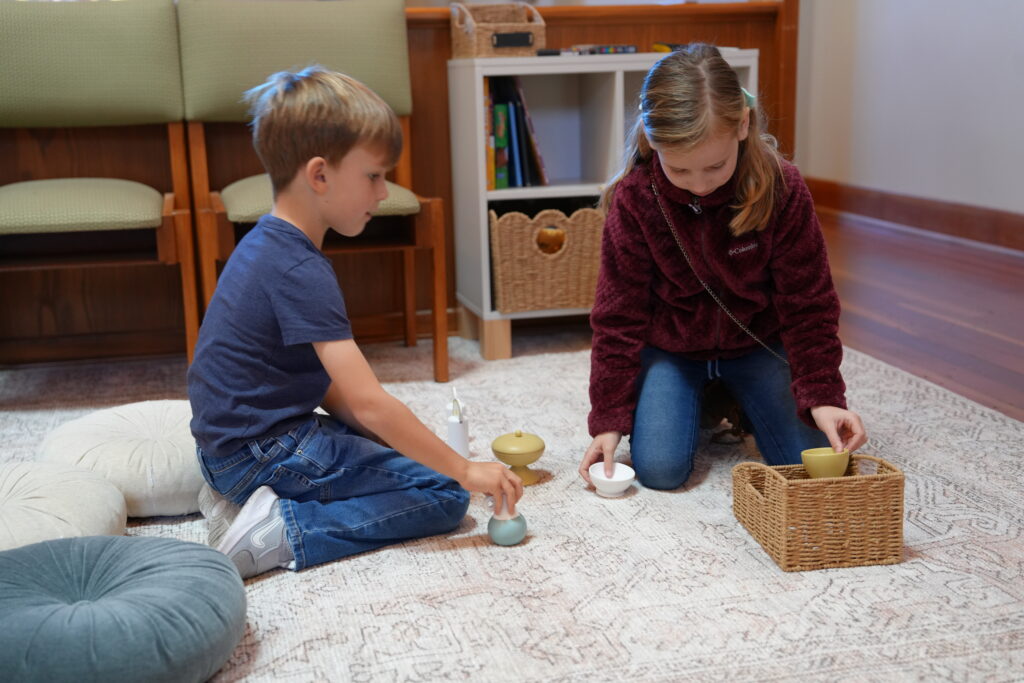
As a mom of five, Kristi Noel loves worshipping alongside her children on Sunday mornings in the specially designed “pray space” at St. Mary’s Church in Laguna Beach.
“Previously, children were downstairs in a playroom-type setting, separate from the parents,” Noel told The Episcopal News in a recent email interview. “But I like to have them with me, so they can learn and we can be together as a family.”
Located at the front of the church and to the left of the altar, the space includes a large neutral-toned rug and round pillows, a shelf with kid-friendly Bibles, and baskets of wooden and other toys. The space allows children “to experience the service in a more developmentally appropriate way,” said Jessica Snyder, another St. Mary’s parent.
Noel said “the wooden toys include an altar ceremony (holy communion) set-up, and the children can use it to follow along with Father Will” Crist, priest-in-charge. “There are magnet toys of the Nativity and a lot of children’s Bibles and books—hardcover and there are also fabric versions for babies.”
About ten congregations across the Los Angeles diocese have designed child-accessible spaces inside churches, where children may participate in varying ways with Sunday worship, according to Missy Morain, Diocesan Missioner for Christian Formation, Children and Youth Ministries.
Grants are available through her office to assist with such spaces and “we are planning to have a soft space at the Diocesan Convention during Eucharist,” for those who are interested in seeing them, Morain said. The soft space will be located near the dais at the front of the convention hall so young people and their families can fully participate in Eucharist with the community gathered.
More than twenty years after she designed a soft space, initially for the 2003 consecration of Iowa Bishop Alan Scarfe, Morain “remains convinced that one of the most important things we can do for children in worship is to give them room to practice.
“When we create a soft space within our worshipping community, we are making a theological statement: children belong here, not someday when they can sit quietly through a service, but right now,” Morain said. “Children learn to worship by worshipping. Soft spaces give young children the freedom to explore, imitate, experiment, and make meaning within the worshipping community. They are not waiting until they are old enough to participate in church. They are already doing church.”
Clare Knutson, 27, an occupational therapist, says her father, the Rev. Bill Knutson, rector of St. Andrew’s, Ojai, is a “’build it and they will come’ kind of guy.” She assisted him in creating what was first known as the pilgrims’ corner, an inclusive space for children at St. Andrew’s. “I started looking at my own experiences as a child in the church and seeing how spaces had been built intentionally,” she told The Episcopal News in a telephone interview from Omaha, where she now lives.
“We wanted to create a space where children and families could show up exactly as they were, where they didn’t have to conform themselves to a space to exist there.”
They removed pews, included rugs, and discovered toys “that would work for a wide range of children, kids of differing ages and of differing ability levels. We didn’t want super-loud toys because you need a certain level of quiet within church. But we also didn’t want the expectation that the kids would remain silent through the entire service.”
Activity bags with Gospel-themed coloring pages and fidget toys were added, along with age-appropriate books in Spanish, English and even Braile. Instead of fire engines, wooden pull toys were included depicting children in wheelchairs, to represent differing abilities as normative.
“We wanted to introduce kids to the idea of disability theology, that we’re all made in the image of God and that is a beautiful thing,” added Knutson, who has multiple chronic illnesses and has used a service animal.
St. Andrew’s average Sunday attendance has grown, from about 40 when he arrived in 2022, to 60, said the Rev. William Knutson. “In four years, I have done 43 funerals and zero baptisms,” he said. “There were lots of discussions about the glorious church of the 1970s. But the town is not that way, we are not that way. I believe God sends us who we are meant to be as church and what we do with it is up to us.”
He took a bit of “ribbing” when the soft space was completed, “because when we dedicated the space, there were no children here. It sat empty for about seven months. We prayed over it. Then, lo and behold, a kid showed up.”
Through word of mouth, that number slowly began to climb and now there are four families who regularly occupy the space, he said.
Similarly, at St. John the Baptist Church in Corona, the Rev. Patricia Stanfield said a soft space was created earlier this year, aided by a Diocesan Innovation Grant through Morain’s department.
“We have chairs and little cubby areas, an area rug and rolling cabinets, a prayer table, a glider rocker for a mom who might be nursing. It doesn’t look like a children’s play area; it just looks like a part of worship.” There are books, a Lego Bible, and children’s communion kits, so children can follow along with what is happening on the altar, and the space is supervised by an adult, she said.
St. Columba’s in Camarillo instituted an inclusive space for children about 18 months ago and is wrestling with removing another pew to make space for additional intergenerational worship, according to the Rev. Michael Anderson, rector.
“The buzzword around here is there are fewer and fewer places where intergenerational engagement can happen, and we’re trying to change the paradigm from ‘there’s not enough people our age’ to this is an opportunity to engage older and younger folks together,” he said.
“It’s an opportunity for us to lean into the family dynamic, whether you have a nuclear family or you don’t—it’s an opportunity to lean into community,” he said.
The congregation received input and planning assistance from both Morain’s office and from St. Andrew’s, Ojai. Knutson added, “It’s worth knowing that we don’t have to reinvent the wheel, we can reach out to one another.”
Knutson said the congregation has experienced steady growth, with average Sunday attendance now ranging about 60, mostly new families, largely through word of mouth and with as many as a dozen children on a Sunday.
“We started small,” he recalled. “We just took out a pew and put a carpet in. We built it and spread the word. We prayed. We did promotional things on Facebook and it grew organically. And I have two baptisms coming up on All Saints’ Day.”