
By Pat McCaughan
Bishop Antonio José Gallardo Lucena and diocesan leadership grappled with compelling and fundamental questions at an Oct. 10 meeting: “what’s the why of the Los Angeles diocese and what’s the why of its governing bodies?”
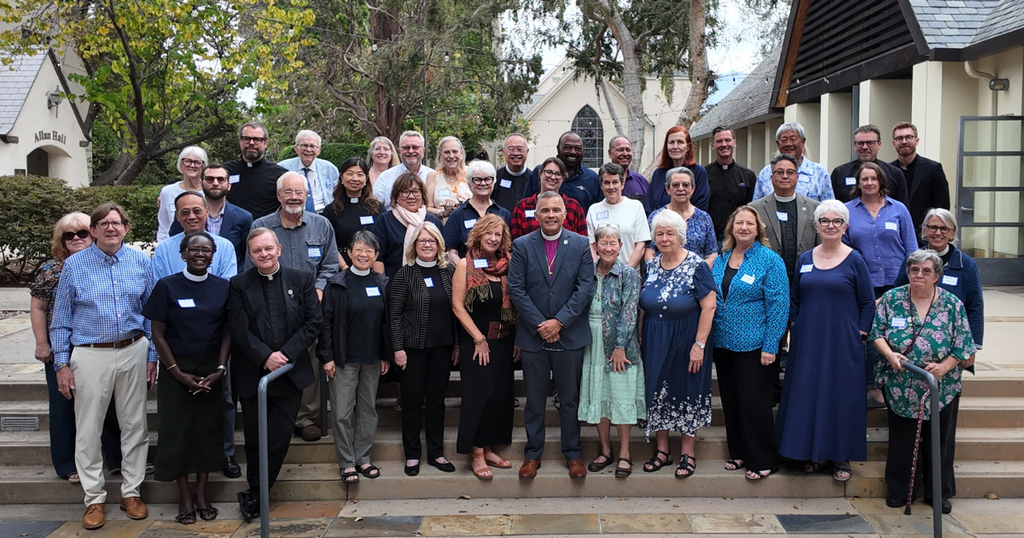
“I had envisioned this meeting from the moment I was elected, as a way to strengthen our relationship and collaboration, while clarifying our specific roles and responsibilities,” Gallardo said. “I want to get to know you better. This is the beginning of our work together,” he told St. John’s Cathedral Dean Anne Sawyer, diocesan staff, and about 40 members of the Commission on Ministry; the Standing Committee, the Corporation of the Diocese, and Diocesan Council.
“I wanted to begin my episcopate with clarity about roles, responsibilities and relationships,” while casting a vision for common mission and ministry, Gallardo said.
The role of staff and governing bodies is to support Gallardo in translating his vision for the diocese into reality, according to retired Minnesota Bishop Brian Prior, a senior assistant to The Episcopal Church Presiding Bishop Sean Rowe and a leadership development coach who facilitated the meeting at the Church of Our Saviour in San Gabriel.
Prior listed some diocesan “whys” as noted by participants: “to enable local ministry; to cast a vision; to be the point for ecumenical and interfaith connections; accountability and honest conversations; to know we’re not alone; global communication and opportunities; and help with administrative and legal concerns.” He described adaptive leadership in terms of identity; context; sustainability and generativity.
Proclaiming the Gospel of Jesus Christ at the local level “is really where it happens” which means everyone has a role in staying connected with, supporting one another, and ensuring “opportunities for ministry to happen.”
Identity involves seeking understanding at individual, congregational and diocesan levels: “What do we bring? What is the why of our work?”
Individually, “We’re all gifted ministers, gifted by the Spirit,” Prior said. “We’re uniquely created in the image of God, and we’re uniquely gifted by the Spirit and uniquely called to follow Jesus.”
Contextually, “We understand that the gospel is experienced in different ways. Leadership begins with the understanding that the Holy Spirit moves in different places, different contexts, different cultures. One of the great blessings of the Diocese of L.A. is the diversity of context and culture here—so how do we really understand the context in which we find ourselves?”
Sustainability, keeping ministry viable, faithful and life-giving, also involves leadership at every level. Every faith community must determine what sustainability means for them. “Those are the resources we have, in terms of time, talent and treasure,” Prior said.
“If a congregation can really get a clear understanding about what their identity is, about their context, they find that model of sustainability … (and) that’s when you become generative, where you discern where the Spirit is leading next.”
Prior recommended incorporating liaisons among staff and the various governing bodies to deepen connectivity, transparency and information flow, as well as to be thoroughly grounded in the Constitution and Canons of both the diocese and the wider Episcopal Church
“Read The Episcopal Church canons first and make sure diocesan canons are in alignment,” he said. “You cannot have any contradictory canons. It is important for you to really understand and be grounded in the canons.”
The Rev. Susan Stanton, diocesan chief financial officer, said diocesan staff have an important role, in supporting the bishop, governing bodies and congregations “and doing all this with Christ’s love.
“The whole is greater than the sum of its parts,” she said. “Staff works with everybody and supports everybody as part of our mission and values. We have knowledge and expertise. We facilitate collaboration. There’s a residual knowledge base at the diocese that can be contextually applied at the parish level.”
Gallardo invited participants to read the canons “as homework” and to agree to some in-person meetings in addition to regular online gatherings.
“We have to find a balance between the technology that gives us some great gifts and opportunities and the value of being in the same room,” he said. “Let’s try to meet in-person at least a couple of times a year.”
Governance: the “who” of the Los Angeles diocese:
The Episcopal Diocese of Los Angeles; Is governed by Diocesan Bishop Antonio José Gallardo Lucena, the chief pastor and spiritual leader, whose episcopate is supported by several diocesan governing bodies, including:
The Diocesan Convention; The 131st annual meeting of the diocese will be held Nov. 13-14 at the Riverside Convention Center. It is the primary legislative and policy-making body, made up of clergy and lay delegates from congregations across the six-county diocese. Convention delegates will vote on an annual budgets and resolutions, as well as elect members to the following governing bodies:
The Diocesan Council; Includes clergy and lay representatives from the diocese’s ten geographic deaneries and senior diocesan staff. Council members develop, implement and oversee diocesan programs, budget and business policies, between annual conventions. Meets the second Thursday of each month from 4 p.m. to 6 p.m.
The Standing Committee: Members are either elected or appointed by the bishop and act as a formal council of advice, approves property encumbrances and recommends candidates for ordination. Meets the third Wednesday of each month, from 1 p.m. to 3:30 p.m.
The Corporation of the Diocese; A nine-member board (eight elected by the convention, plus the bishop) responsible for legal, financial, and property matters.
The Commission on Ministry:A30-member elected and appointed lay and clergy board, that offers support and works with the bishop and diocesan Office for Formation and Transition Ministry to guide individuals exploring a call to lay or ordained ministry. Meets four weekends a year, plus additional days as needed for discernment and formation interviews.