
by Pat McCaughan
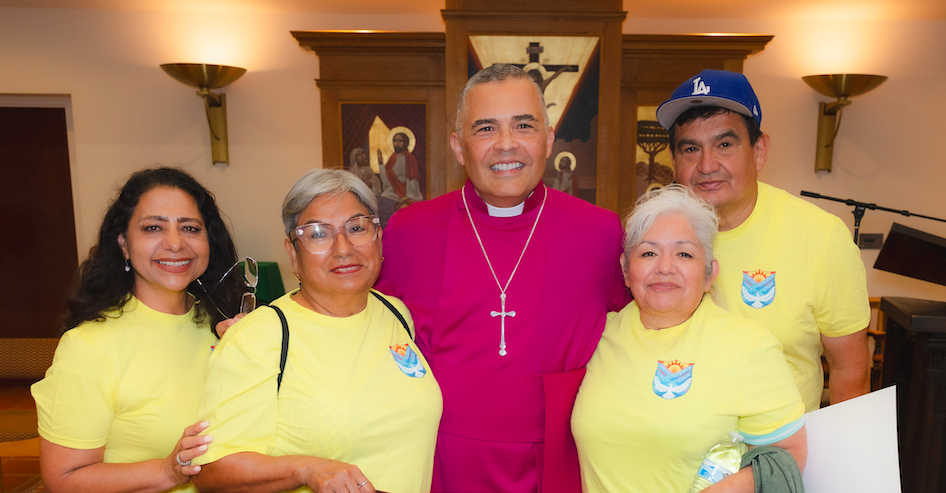
Bishop Antonio José Gallardo Lucena says that, by using his entire name, he is reclaiming an identity that “got lost along the way” when he moved from Venezuela to the United States 33 years ago.
Then a graduate student at Lehigh University in Bethlehem, Pennsylvania, he ordered a taxi at the airport. After an hour of waiting, “I went back to the front desk and asked what happened. They said they have come three times and didn’t find you. I asked, who are they looking for, and they said, Mr. Gallardo. Never in my life had I heard my last name as Gallardo. That was my first exposure to that name in this culture.”
His experience “is probably the story of every immigrant,” he added. “Whenever we go to a new place, when the culture is so different, something like our name gets lost. But when that next taxi came, I didn’t know what they said, I just jumped in it.”
Now, he intends “to show the world exactly who I am,” he said. “I want to be known by my full name because it has meaning. I carry not just the last name of my father, but also the one from my mother. I want the diocese to know that’s what I bring to the table. Something as simple as a name carries great significance for many of us, especially immigrants.”
Cultural naming traditions can be misunderstood—even something as seemingly common as electronic fillable forms, “assume a person has only one last name,” says the Rev. Carlos Ruvalcaba, associate priest at St. Stephen’s, Hollywood and St. Barnabas, Eagle Rock.
The use of double last names among Latin American and other communities ensures “that both sides of a person’s ancestry are acknowledged and preserved, strengthening family identity and heritage, and even geographic location,” he said.
His surname, Ruvalcaba, is strongly associated with western Mexico, especially Jalisco, Zacatecas, and nearby states, while Rosales is more widespread across Mexico, Spanish-speaking Latin America, and the U.S. Hispanic/Latino diaspora, he said.
Getting names right is “more than paperwork,” he added. “Taking the time to understand a neighbor’s name is one way we honor their dignity and deepen our life together as the Body of Christ.”
When Korean women marry, their last name is added to their husband’s, according to the Rev. Sun-Hwan Spriggs, deacon at St. Paul’s Church in Tustin. Unlike the Western world, in many Asian cultures, last names precede the first, or given name, and there typically is no middle name, said Spriggs, who came to the U.S. as a 16-year-old student.
“Lee Sun-Hwan is my Korean name,” said Spriggs, who is married to an American. “Sun means goodness, kindness. Hwan means brightness, and because of the Chinese character, it has the component of fire. It means bright as fire.”
And family names are the most important, she added. “When you meet people, the first question they ask is, who’s your father? And what kind of Lee are you? There are different branches of Lees, and from your given name, we can figure out if you are an uncle or nephew or where you are in the genealogy.”
The family name emphasizes more than “just the nuclear family,” she said. “I’m talking about tribe, clan.” Living in the U.S. since 1971, she reversed her name order, and took her husband’s name, in alignment with Western culture, she said.
The Rev. Hsin-Fen Chang, vicar of St. Thomas Church in Hacienda Heights and convenor of diocesan Chinese ministries, said she also follows the Western practice for use on official documents.
“Western culture emphasizes individualism,” Chang said. “Here, your first name is considered more important and can represent your identity; the given name always goes first. But the Chinese emphasize belonging to family and country. Family names represent which lineage you belong to,” said Chang, who is Taiwanese.
“It’s like our address, too. We write the country’s name first and then the city and then your home address. While here, it’s the opposite. You put your house number, then the city and gradually you tell people which country you’re from.”
Chang is among the top five most popular Chinese family names, she added. While some immigrants take Western given names, she has always been known as Fennie, she added. “That’s what my father called me when I was little. Hsin in Chinese could mean confidence, face and Fen means fragrance,” she told The Episcopal News. “My father is a Christian, so he gave me a name that says, basically, you have a beautiful face that smells of a good aroma of Christ.”
After the British colonized Uganda, children received both traditional and baptismal names, said the Rev. Joy Magala, rector of St. Mary’s, Los Angeles. “Last names usually follow the clan. In Uganda, there are 52 clans and each has a group of names that belong to that clan. When someone says Magala, they know right away that they belong to the Kobe clan. Kobe, like a zucchini or pumpkin family.”
And family members add names, she said. “My daughter is Takira. My husband Sam’s mother thought she should also be Ikeira Kyenalina, which means, ‘this is what I’ve waited for, now I can die kind of thing’. It’s possible for people to have multiple names and anybody can add a name if they want. They just keep adding names.”
Similarly, the Rev. Mary Tororeiy, rector of St. Mary’s, Lompoc, said Mary is a baptismal name and Jerobon is her traditional name, “a name that tells when I was born or where I was born. If anybody hears my name, they know I was born during the rainy season.”
“If it’s raining, it is planting season and God has blessed us. The idea is of God blessing us, and we are in communion with God and the ancestors and everything is perfect.”
There are 42 tribes in Kenya; she belongs to the Kalenjin people and seasonal naming is important. “It’s important, because of the African philosophy of time, because time is value. So, when you sit with people, you are in that moment,” she said. “You don’t look at your watch. You create time to be with people and by naming children according to the time of day or season, it denotes the importance of that particular time.”
She added: “Tororeiy is my dad’s name. Tororeiy speaks of the type of family or what they did in terms of their economic activities. Tororeiy is a combination of two words—their grandfather had so many cows and very healthy huge bulls and so the name means glorious bull.”
“Most tribes in Kenya keep cows. Cows are very important in economic value,” she said. “You could have a huge bank account but if you don’t have a cow, you are very poor. Whenever people hear my dad’s name, they know he was a person of status and wealth and community.”
–This article was inspired by the Rev. Carlos Ruvalcaba