
by Pat McCaughan
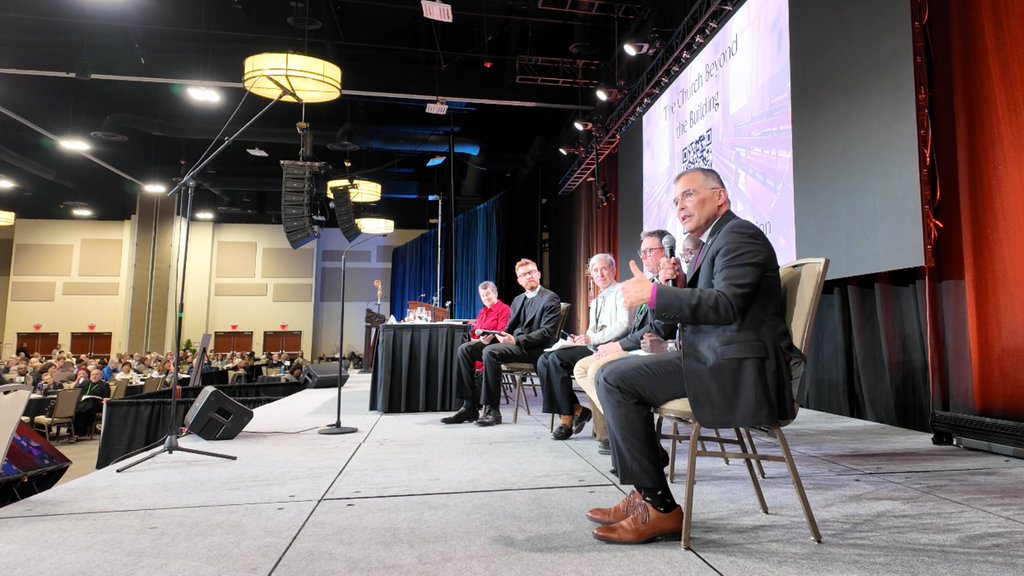
After years of shared worship and outreach ministries, members of St. Paul’s Episcopal and Shepherd of the Desert Lutheran churches in Barstow now consider themselves one family of staunch “Lutherpalians” with plans to sell a building to fund new service opportunities, Canon to the Ordinary, the Rev. Canon Jon Feuss told convention during a Nov. 13 “The Church Beyond the Walls” panel discussion.
Initially, the congregations had alternated meetings between their two locations but decided recently to sell the former St. Paul’s church for a purely practical reason—it lacks air-conditioning, which the Lutheran church has, he said.
“The two communities figured out they needed to work together in order to continue to exist,” said the Rev. Dr. Mary Tororeiy, former St. Paul’s vicar, who is now the rector of St. Mary’s, Lompoc. They “were trying to find a way to continue being present in Barstow as a faith community and they realized that if they didn’t get together, they will cease to exist.”
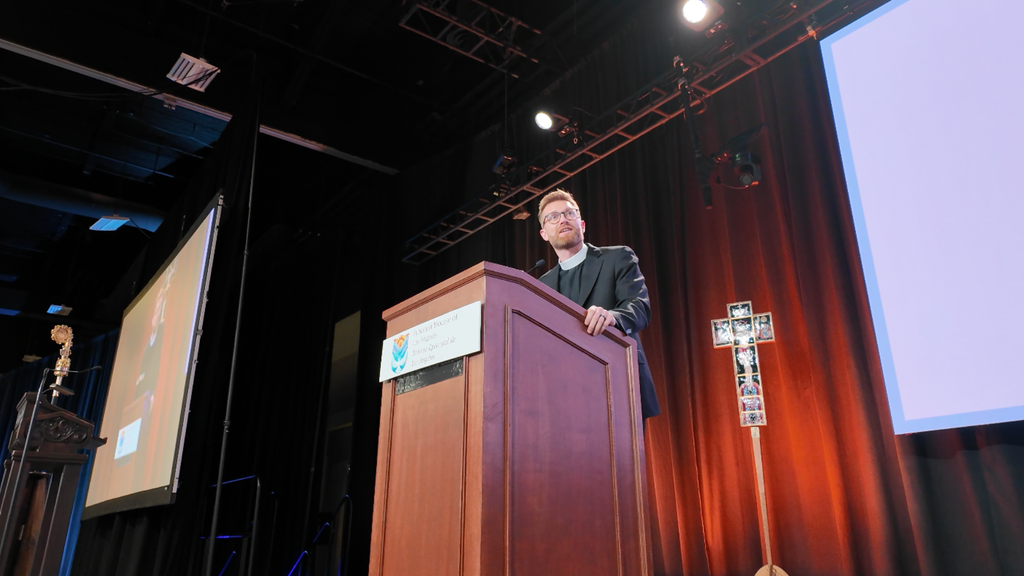
The discussion intended to initiate a conversation occurring among the wider Episcopal Church and many mainline denominations, where congregations are weighing ministry options without the expensive encumbrance of maintaining aging buildings.
Bishop Antonio José Gallardo Lucena also discussed creation of a strategic process to discern such opportunities in the diocese, and ways to safeguard the proceeds from sales for future ministry needs.
The scarcity of funding for affordable housing projects, changing demographics and economics have created a shift from former diocesan policies to avoid sale of church properties. This is a moment, “when it seems right to reexamine our relationship with sacred property,” Feuss said.
Similarly, St. George’s Church in Hawthorne celebrated a final worship service Feb. 15, 2026, after dwindling membership and resources prompted a decision to let go of their property and currently there is a prospective buyer for the property. “Candidly, I suspect there will be more communities that discern their own closure as time goes on,” he said.
Such “Lazarus” moments may feel like death but create resurrection opportunities, Feuss said. “These communities who discerned closure rise again when the spirit of their congregation is infused into their nearby congregations, enriching those communities with their gifts and charisms, forming even stronger communities of faith,” Feuss said. “And although their ministry in that particular time and space concluded, their resources will breathe new life into ministries not just in the here and now, but ministries we will be called to in the future, ministries unknown to us, ministries we, as a diocese, will discern together.”
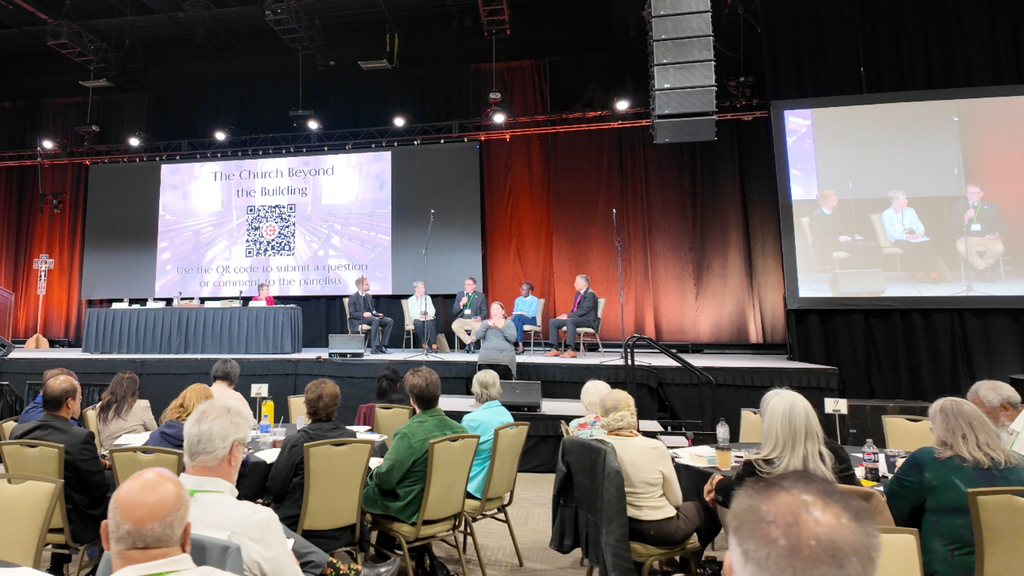
Panelists also included the Rev. Canon John Watson, Canon for Christian Mission and Leadership; Ms. Mary Pierson, parishioner of St. Cross in Hermosa Beach, and Trustee of the Corporation of the Diocese; and Gallardo.
Watson has led diocesan Requiem or Renaissance efforts, an opportunity to help struggling congregations to decide their future path.
“It might be a partnership with other congregations and how to use their buildings. Or it may be an opportunity to use their building in another fresh way. While these options are open, it’s an opportunity to ask those questions which we do often don’t get a chance to ask.”
Gallardo said one his phone calls and road trips involved the sale of St. Paul’s. He immediately wanted to deconsecrate the building. “It wasn’t easy,” he told convention. “We did a regular visitation, with all the bells and whistles. I found the community acted as one. There was no way, honestly, for us to know who was Lutheran or who was Epsicopalian. They were very engaged and that was inspiring.”
Together, they listened to one another’s stories.
“We cried together as people shared how difficult it was to depart from that place where some had met their loved ones, where there were baptisms, all the rites, the Sundays together. I walked away from that encounter realizing that we could live in that tension of grief and new life,” Gallardo said. “It’s like church on Holy Saturday. We may know Christ has died and may not know fully what is coming but it is a very sacred moment, a very moving opportunity.
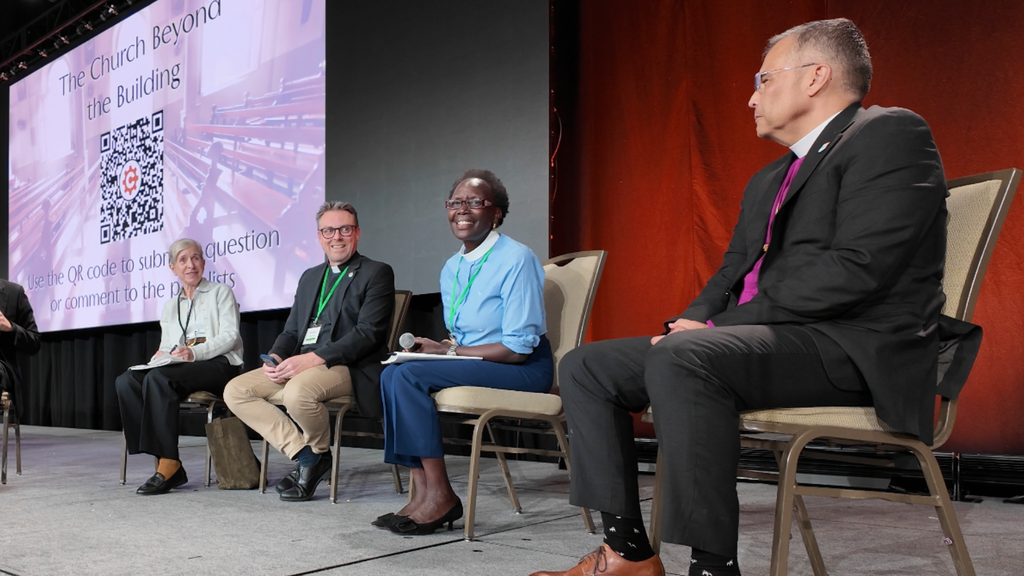
“It gave me great hope about our church,” he added. “They showed openness about what God has in store for them. They are now in a better place; they are going to give life to what is coming for us as a diocese.”
Panelists cited the sale of The Episcopal Church headquarters in New York City and efforts underway in the Diocese of California to sell church property and create a trust to fund income for church planting and revitalization. Similar efforts in the Diocese of Massachusetts have involved a loan program to assist revitalization of churches and to help congregations become more eco-friendly.
Gallardo said decisions about what to do with proceeds from sales of church properties will be made by governing bodies, and not a single individual. “We are trying to be good stewards of legacy funds in our diocese,” he said. “Let’s work together toward deciding what God is calling us to do, how to do it, and to decide priorities and how to allocate proceeds of funds.”
Future possibilities include congregational mergers or clusters of several churches led by a single clergyperson. Larger congregations supporting smaller ones are another possibility. “We just want to travel with each congregation, in moving forward,” Watson said.
Pierson said Corporation of the Diocese trustees started a diocesan wide inventory about 18 months ago, to understand where assets are located and to plan an annual review of both sacred and nonsacred properties.
Ministry does not depend on geographic locations or average Sunday attendance, Gallardo said. “In all places, God is at work,” Gallardo said. “The goal is to determine which places want to continue and then support them to find hope in all the work you’re doing and then support you, including the struggles you’re going through.”