
By Pat McCaughan
By the time “Clear the Road to Freedom” walkers reached Los Angeles Oct. 6, they had focused national media attention on inhumane ICE detention center conditions, raised $65,000 for bonds for detainees, built extensive grassroots support and, although exhausted, sunburned and blistered from their 96-mile trek in extreme heat, were dancing in the streets, says the Rev. Canon Jaime Edwards Acton, an organizer and diocesan Sacred Resistance co-chair.
“It was like we had endless energy. It was beautiful” and only the beginning, Edwards Acton told The Episcopal News Oct. 7. “We’re going to keep showing up, keep insisting that something be done, that centers be closed down, that the immigration system be fixed and that people be held accountable, and to make sure that these places are humane.”
The interfaith walk, itself, was the message. Organized by the diocesan Sacred Resistance, CLUE, or Clergy and Laity United for Economic Justice, and Nefesh L.A., a Jewish spiritual community, the pilgrimage drew widespread attention from such Spanish and English language media outlets as Univision , the Rachel Maddow Show , MS Now, L.A. Local , USA Today Network/Visalia Times-Delta and many others, he said.
Walkers also drew a groundswell of local and individual support, Rabbi Susan Goldberg, Nefesh founder and a pilgrimage organizer, told The Episcopal News on Oct. 3, when the group reached Upland, about halfway to their destination. “People are showing up and saying, ‘I saw this on Tik Tok’ and on social media, and I decided to come walk for the day, and they are having transformative experiences.
“That’s the beautiful part about pilgrimage,” she added. “We have woven together a beautiful sense of group and shared purpose,” and are learning about each other. Nefesh had hosted a shabbat meal at an evening stop in Fontana, she said. “We have time to reflect together, the opportunity to hear testimonies of those who’ve been held in Adelanto,” where at least five people have died amid allegations of detainees being served dirty water, worm-infested food, and refused medical attention.
There are many opportunities to join the supporters, said the Rev. Rob Muthiah<cq>, a Mennonite pastor and CLUE’s Director of Leadership Development. “Most people in detention don’t have criminal records, but even if they did, they still bear the image of God. They still have legal rights. The administration is ignoring those rights. The level of cruelty there for me, as a Christian, seeing people who identify as Christians, perpetrating this – God, forgive us.
“We want everybody to think about what’s your moral core and then what can you do,” he added. “Some will show up to protest; others will push for legislation; others do letter drives. We need it all and it doesn’t have to look like walking 96 miles. We can do it together.”
The 96-mile distance is meaningful, and calculated, said the Rev. Jennifer Gutierrez, CLUE’s Executive Director and a United Methodist Church pastor. “It’s a long walk for us but an even longer trek for families trying to visit loved ones. The objective is to break people down.” The walkers also aimed to raise money for CLUE’s bond fund which, according to The Progressive Magazine as of May 2026 had raised and paid more than $1.5 million in detainee bonds.
The detention center intentionally was located in a remote space, Edwards Acton said. “This camp is built 96-1/2 miles away from downtown L.A. in the high desert, in the heat, away from the eyes and ears of Angelenos and 96-1/2 miles away from family members who want to visit loved ones, 96-1/2 miles away from the legal representation which everybody deserves.
“Adelanto is a long way from a lot of things by design, not by accident and it speaks to the cruelty, the intentionality of this federal government and our immigration policies—and you see this all across the country,” he said. “We hoped that each step we took brought a little bit closer to people in L.A. and across the country and the world, the stories and messages of those suffering and going through this.”
E.B. Stapp welled up as she recalled the signs bearing images of detainees who died at Adelanto and the account shared by “a man, who was there for six weeks and was bonded out by CLUE. He said his children were so traumatized by his detention that now they don’t sleep. They keep getting up in the night to make sure he hasn’t been taken away from them again.”
Participating the first and last day of the walk, she aimed to express solidarity so detainees would know they are not forgotten. “It was an incredibly moving experience, rather than being angry about the worst of humanity, to just be around the best of humanity,” said Stapp, a member of St. Mark’s Church in Upland, which served as an Oct. 3 rest and snack stop for the walkers.
Gutierrez said the Upland welcome was emblematic of support received along the way from many churches and others. “People were clapping and cheering us as we arrived. There was a beautiful spread of snacks and cold drinks, charging stations for phones, signs welcoming us.”
The Very Rev. Keith Yamamoto, St. Mark’s rector, said the congregation felt “honored to host the pilgrims. For me, their witness is a reminder of the unjust incarceration of Japanese Americans during World War II and our baptismal vow to uphold the dignity of all people.”
Edwards Acton agreed, noting that as the walkers had passed the Santa Anita Racetrack in Arcadia, “we were joined by young people from Nikkei Progressives,” a volunteer Japanese American grassroots organization opposing systemic injustice. Similarly, Japanese Americans and supporters began a four-day, 48-mile pilgrimage Oct. 7 from Seattle, Washington, to the Northwest ICE Processing Center in Tacoma to protest the administration’s policy of mass deportations, he said.
The Adelanto walkers were aged 9 months to a 91-year-old retired priest and were Black, White, Latino, Asian, represented organized labor, activist organizations, faith communities and were random individuals. Some joined in for a time, along “scary turns” on the Cajon Pass, over the rough terrain of the San Gabriel mountain range, to moving single file on dirt roads, Edwards Acton said. Churches and individuals offered water, umbrellas, food, and respite. Schedules were adjusted to early morning and evening walks to avoid triple-digit heat.
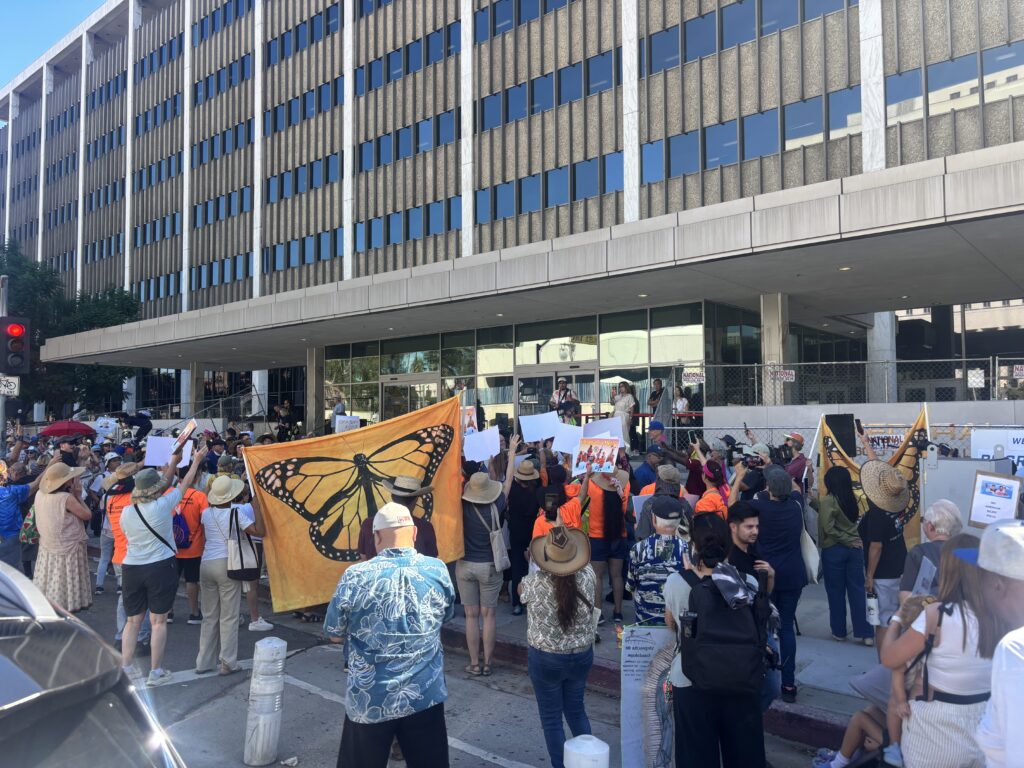
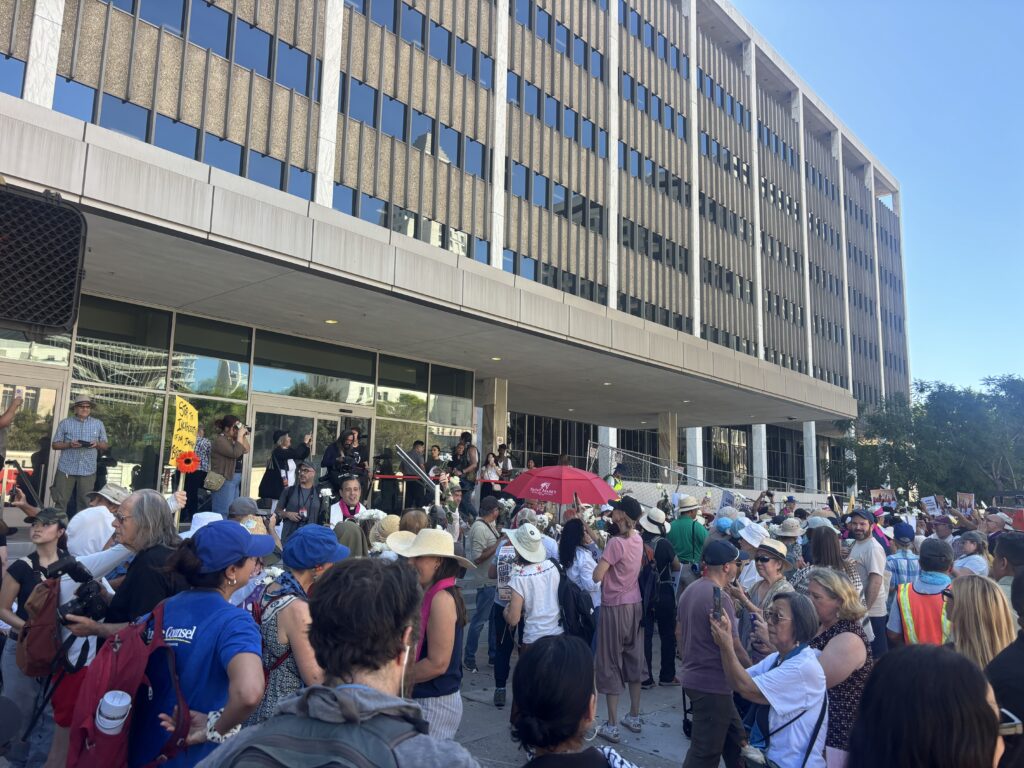
Fron the first step to the last, there was a tremendous groundswell of support, he said. “People turned out in a big way,” Edwards Acton said. “Even up in the mountains, out of nowhere, 30 people suddenly are walking with us, and the first thing they say is, we support what you’re doing.” Hundreds of supporters, including Korean and Indigenous drummers, greeted the walkers as they reached their destination, the Metropolitan Detention Center in L.A.
Volunteers from Sacred Resistance Orange County, organized by Archdeacon Laura Siriani and Laura Boysen-Aragon, provided lunch and cold drinks when walkers reached L.A. Boysen-Aragon is development director at the Loyola Institute for Spirituality, affiliated with St. Paul’s in Tustin and in discernment for the Episcopal priesthood.
Edwards Acton said Sacred Resistance’s “mission is our call to help Episcopal communities live out our baptismal covenant and the promises we make, to persevere in resisting evil. We will make sure we fight against anything that seeks to distance us from God or that says we’re less than beloved. And to strive for justice and peace among all people, to see Christ in all people we come across and to treat them accordingly. We’re establishing hubs across the diocese; no matter where you are geographically, there’s a role to play.”
And the next step? “Election defense,” he said. “We want to help make sure the mid-term elections happen, the ballots get counted, that Congress seats people. We want to protect our electoral process.”