
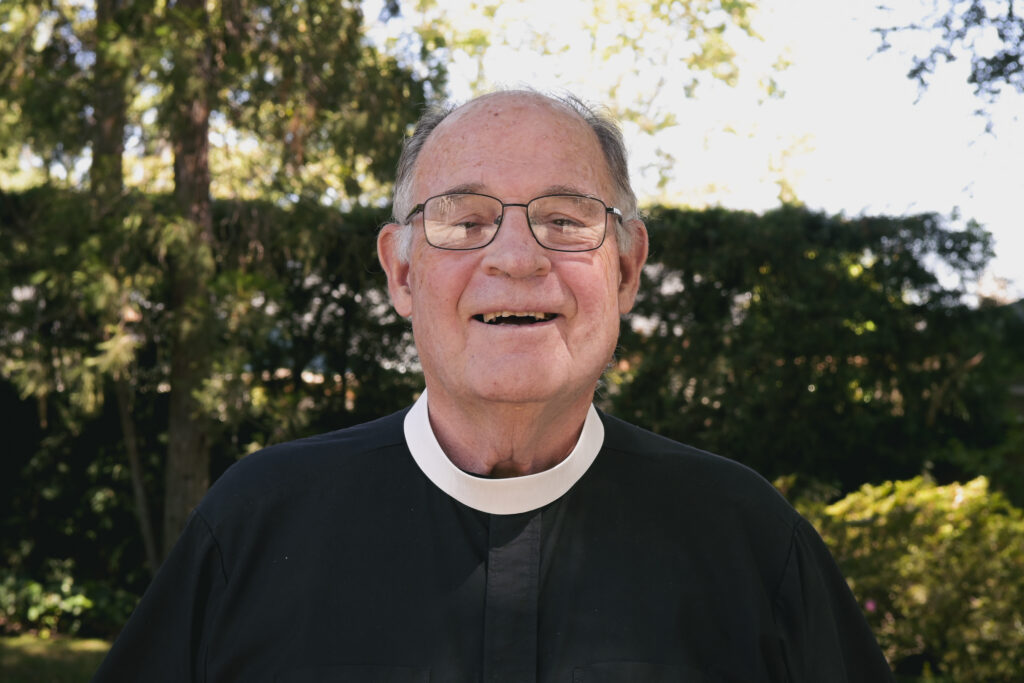
In advance of our November 7 Introduction to the Diaconate workshop, Deacon Bill Doulos shared with us his journey to the Diaconate, and the role that Bloy House played in his formation. For more information on the November 7 workshop, please visit www.bloyhouse.org.
Once a Deacon, Always a Deacon!
A conversation with the Rev Canon Bill Doulos
Bill is a much-loved member of the Church of Our Saviour in San Gabriel, where he has been Deacon for many years. He is also the guiding light behind one of its important ministries, Jubilee Homes, which he founded in 2002. For 21 years, Bill has served the Church of Our Saviour as the Director of Jubilee Homes sober living for 50 adult men and women and have become a beacon of support and hope for men and women struggling with addiction. He was ordained a deacon on May 17, 2014, by Bishop Jon Bruno, and on November 11, 2022, Bishop John Harvey Taylor named him an Honorary Canon of the Episcopal Diocese of Los Angeles. We asked Bill if he ever thought that his journey would lead him to where he is today.
Bill Doulos:
I might say that I began my journey to “servanthood” when I was a grade school student sitting on my grandfather’s knee as he explained the Bible to me with the help of Halley’s Bible Handbook. Grandpa Lane was a fundamentalist who believed that the world was created in six 24-hour days. I think this experience of occasional learning of the Bible made a favorable impression on my childhood mind. And I was predisposed to have a favorable impression of the Church, because as a preschooler I was blessed each Christmas with a small box of chocolates given by Pastor Melhorn. (I later, when I was in my 70’s, spoke with Pastor Melhorn’s daughter, who told me that Mrs. Melhorn personally made chocolates for Christmas and gave them with love to all the preschoolers. Somehow my childhood mind sensed that they were given with a special love!
When I was in junior high school, my mother asked me during a snowy winter day in Pittsburgh to go across the street and shovel Mr. Fisher’s walk. He had fallen and broken his leg a few weeks earlier. I never received thanks or pay for this act of childhood kindness, and I never met Mr. Fisher. But I knew a special warmth in my heart that served as a reward. When I was in high school during the summer of 1960, I read the Bible cover-to-cover. (I later joked, during a sermon at Church of Our Saviour, that I could no longer read that Bible in the same way, because during one of my many moves the front cover fell off and was lost!) Also, when I was in high school, I attended the New Wilmington Missionary Conference for a week during two consecutive summers, and I gave my life to Christ under the preaching ministry of Dr. Louis Evans. So you see, from pre-school on I had a destiny to be a servant. And I think, shortly after I was baptized in the Lutheran Church by Pastor Melhorn, in January of 1944, I knew I would become a Churchman!
I journeyed to Koinonia Farms in the summers of 1970 and 1971, after working for Young Life Campaign in Pittsburgh. I got a taste of radical Christianity from this rural outpost in southwest Georgia, witnessing to peace and integration and sharing, during a materialistic and militaristic and segregationist culture. When I got married to Sybil in 1971, we eventually decided, along with other folks at Koinonia, to adopt a neutral and meaningful and biblical last name. We chose “Doulos,” the New Testament word for “servant.” Then I attended Fuller Theological Seminary in Pasadena, graduating in 1973. When I graduated it was as if I stood on the steps of the seminary and asked God what I could do for the rest of my life! I was 30 years old. God said, “I have some bad news and some good news for you.” I said, “Give me the bad news first.” God said, “There’s only one church in America that would hire you to be a servant to the poor,” I said, “What could the good news possibly be?” And God said, “It’s only two blocks west of where you are standing right now!”
Sybil and I had already been drawn to All Saints Church because of their Rock Mass one Sunday evening a month, and because we had become volunteers at their outpost on Union Street serving the poor of Olde Towne, Pasadena. I was employed there full-time by Sister Alice Callaghan and by their Rector, the Rev. George Regas. I retired as the Director of Union Station, after we had built a new home for our soup kitchen and overnight shelter, in 1990. Then I concentrated my work with All Saints on building a network of sober living homes for patrons of Union Station and others who had experienced homelessness, incarceration, mental illness and addiction. They could stay at Union Station’s shelter for a month or two, but they could graduate into one of our “Jubilee Homes” for a year or two, during their hoped-for transition into mainstream society.
I journeyed to Koinonia Farms in the summers of 1970 and 1971, after working for Young Life Campaign in Pittsburgh. I got a taste of radical Christianity from this rural outpost in southwest Georgia, witnessing to peace and integration and sharing, during a materialistic and militaristic and segregationist culture. When I got married to Sybil in 1971, we eventually decided, along with other folks at Koinonia, to adopt a neutral and meaningful and biblical last name. We chose “Doulos,” the New Testament word for “servant.” Then I attended Fuller Theological Seminary in Pasadena, graduating in 1973. When I graduated it was as if I stood on the steps of the seminary and asked God what I could do for the rest of my life! I was 30 years old. God said, “I have some bad news and some good news for you.” I said, “Give me the bad news first.” God said, “There’s only one church in America that would hire you to be a servant to the poor,” I said, “What could the good news possibly be?” And God said, “It’s only two blocks west of where you are standing right now!”
I gained some experience with “transitional housing” when I worked with the Church and Temple Housing Corporation on Skid Row Los Angeles, representing All Saints Church and Leo Baeck Temple. (Each of these prominent congregations thought they had top billing in our joint enterprise, because the Jews read from right to left!). I managed two hotels, the Genesis and the Pershing, at the corner of Fifth and Main, certainly one of the most forlorn corners in LA. We had a joint Hannukah-Christmas service at the Genesis one year. I stood in a circle next to Rabbi Sandy Ragins, who sang more lustily than I “O Little Town of Bethlehem.” I asked him after the service how as a Christian I could represent the interests of his Jewish congregation. He said, “Be the best Christion you can be!”
Sometime in the late1970’s, I picked up a book by Napoleon Hill called “Think and Grow Rich.” I thought, and I grew rich! Between 1983, when I bought the Raymond House, and 2002, when I had developed my own personal drug addiction, I had accumulated nine homes in the Pasadena area dedicated to transitional housing to give addicts an opportunity to recover. In September of 2001 I had watched the towers fall in New York, and I experienced my own collapse of my life work because of my hidden (up until then) addiction. All Saints sent me to a recovery program in Arizona in the fall of 2001. I got on the road to recovery, and I was grateful (in the end) for the intervention.
At the same time, I decided to accept the offer from the Rev. Denis and Lynette O’Pray to continue my ministry at Church of Our Saviour, in lieu of “returning to the scene of the crime.” I didn’t learn how to be a landlord or a general partner in seminary. I reorganized my real estate by liquidating some of my homes, paying off my investors, accepting the contributions of many of my investors to the Church of Our Saviour, and starting fresh with “Jubilee Homes.” The Church wound up with four homes with 15-year mortgages at 55% loan to value. And now I have not only cleaned up my act and my addiction, become a more understanding counselor for my residents, and lived to see the day when the homes are now fully paid off. My equity in the homes was a small price to pay for the return of my precious life!
And on the way to this glorious reality, my new Rector at Church of Ous Saviour, the Rev. Michael Battle, suggested I become a Deacon. “What’s a Deacon?’ I asked. He said it was what I had been doing for the past 35 years, except for the addiction part! I had to go back to seminary part-time at Bloy House to become Anglicanized! And five years later, in 2014, I became a Deacon! Even though I retired as the Director of Jubilee Homes in 2023, when I turned 80 years old, I still make pastoral calls, set the table and read the Gospel, and manage the Raymond House. Once a Deacon, always a Deacon!
I consider it a privilege, and far greater a fulfillment for me than when I got a taste of servanthood by shoveling Mr. Fisher’s walk!