By Pat McCaughan
Blessing of city, diocese offered from historic outdoor pulpit
View video clips (opens in a new tab); view the full liturgy (opens in a new tab).
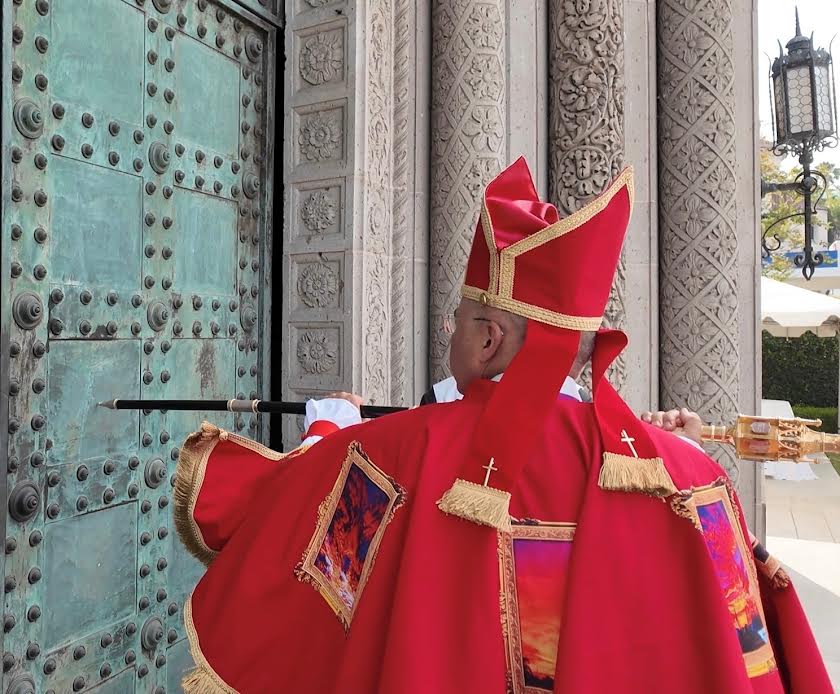
The Rt. Rev. Dr. Antonio José Gallardo Lucena knocked three times with his crozier on the doors of St. John’s Cathedral (opens in a new tab) July 12, signaling the start of a joyous afternoon bilingual service installing him in the cathedra – the bishop’s chair near the high altar — but not before he answered to the congregation’s children.
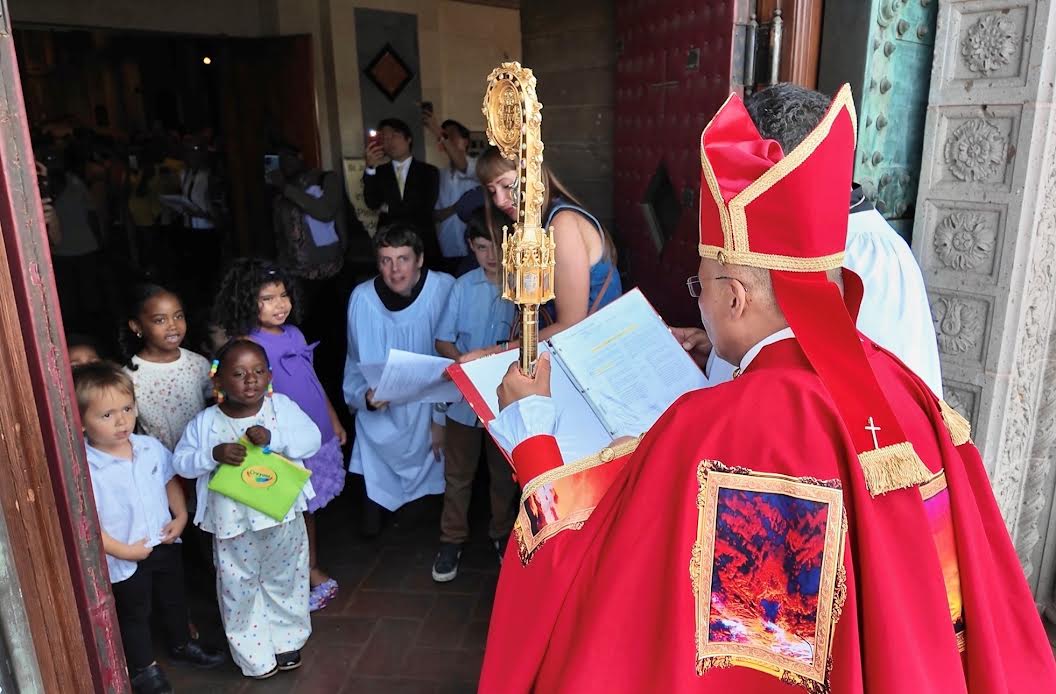
“Who are you, and why do you request entry?” nearly a dozen young voices rang out as the century-old Romanesque-style cathedral’s massive doors opened. “Why have you been sent to us?”
“I am Antonio, a servant of Christ, and I come as one seeking the grace of God, to travel with you in his service together,” Gallardo L. responded. “I am sent as bishop to serve you, to proclaim the love of Christ and with you worship and love him with heart and soul, mind and strength.”
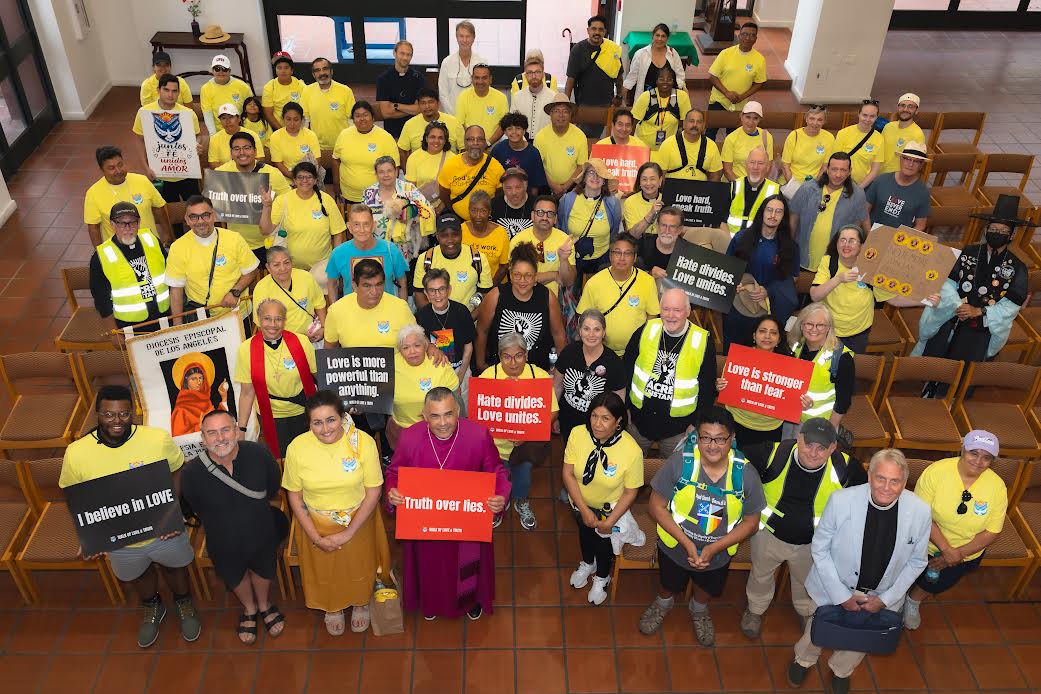
Gallardo L. had just led about 100 followers carrying signs proclaiming love and truth – the theme of his episcopate – through city streets. View video here (opens in a new tab) .
From St. Paul’s Commons, the diocesan headquarters in Echo Park, across the 101-freeway bridge to Figueroa Street to the cathedral’s West Adams district near USC, followers wearing black-and-white Sacred Resistance (opens in a new tab) and yellow “Love and Truth” T-shirts carried signs proclaiming: “Lead with Love. Walk with Truth,” “Truth over lies,” “Love is stronger than fear,” and “Justice is what love looks like in public.”
Love in action was also Gallardo L.’s message in his first sermon as bishop, addressing more than 400 people – family, lay, clergy and civic, interfaith and ecumenical guests – present and some 700 online. Gallardo L. was visibly moved as he recalled a personal encounter, not unlike Jesus’s three-fold question of Simon Peter in John 21:15-17, “Do you love me?”
With each affirmative response, Jesus commissions Peter to “feed my lambs, tend my sheep, feed my sheep.”
“I never saw myself as a priest, but there were signs from others,” including nuns at the Holy Infancy church community in Bethlehem, Pennsylvania, where he lived initially, after moving to the United States. “One day, in 1994 one of the sisters, Sister Beda, told me: ‘Antonio, every Wednesday we are praying for you to become a priest’.
His response drew laughter from the standing-room-only gathering: “My answer was, ‘Sister, please stop praying.’
“I was ordained a priest, and throughout that journey, from discernment through seminary, I was not entirely sure that this was a call for me,” he said. “Then one day, as I was doing seminary homework, with the TV in the background playing a series called ‘The Bible,’ I heard a question being asked, ‘Antonio, do you love me?’ Since then, I have not doubted my call.”
Gallardo L., who later blessed the city, the diocese and its communities and peoples, also commissioned the gathering to answer Jesus’s call to love and serve.
“In our Christian tradition, we talk about a call, which is God’s gracious invitation and summons to enter into a relationship with Christ, to participate in God’s mission in the world, and to become the person God created us to be through the power of the Holy Spirit.”
Gallardo L.’s brother Henry, an Arcadia resident, told The Episcopal News the two-day celebration – beginning with the new bishop’s consecration July 11 at All Saints Church in Pasadena – was emotional for him, also. He believes his brother’s ministry will not only bless the people of Los Angeles, he said, but that those blessings will also extend to their birthplace, Venezuela, which has been rocked by devastating earthquakes killing nearly 4,000, injuring 16,000 and displacing more than 18,000.
“This is very special,” he said through an interpreter. “I was able to witness how much all of you love my brother and are going to work with him and help him. He takes liberty and freedom and respecting the dignity of every person very seriously.”
The offertory collection was dedicated to support Episcopal Relief and Development’s International Disaster Fund. ERD is providing critical relief and long-term recovery support to those impacted by the earthquakes. Contributions may be made to ERD here (opens in a new tab) .
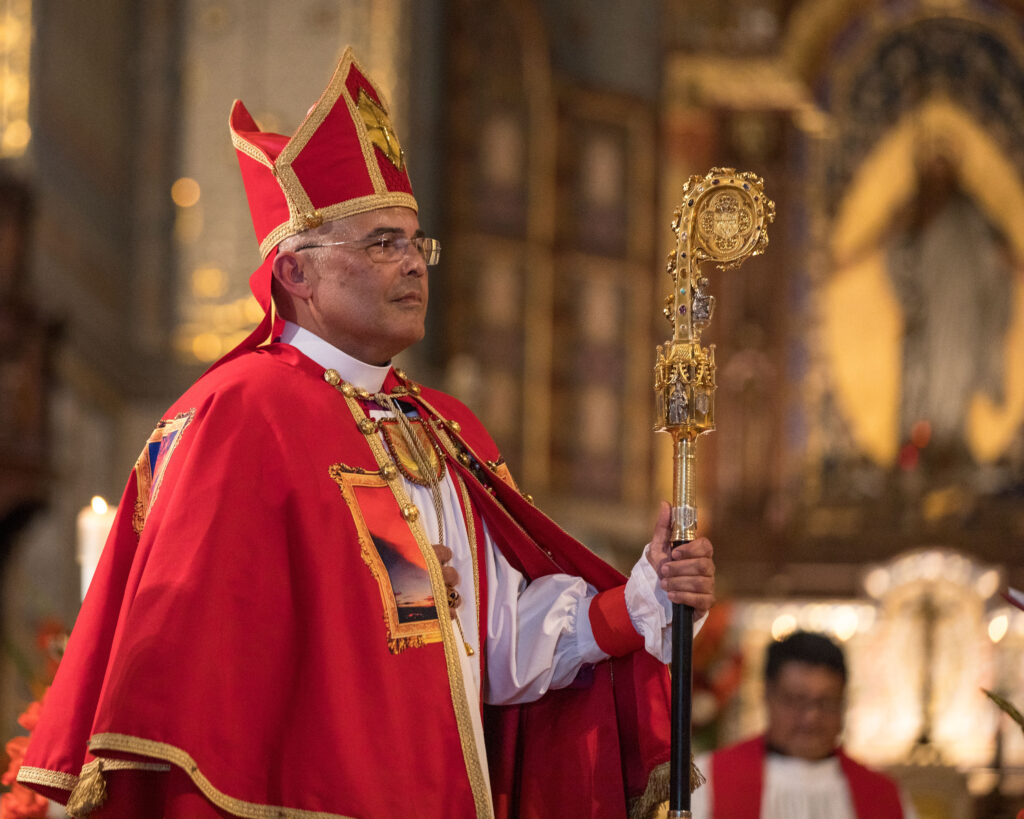
As the service began, the cathedral’s dean, the Very Rev. Anne Sawyer, welcomed Gallardo L. “to your cathedral church, the symbol and center of your pastoral, liturgical, and teaching ministry in the diocese.” The bishop and dean then moved to the oak cathedra, hand-carved in 1924 by artisans from Germany’s Oberammergau Passion Play, featuring scenes from Acts of the Apostles, and inlaid with wood believed to date from 1079 as part of England’s Winchester Cathedral.
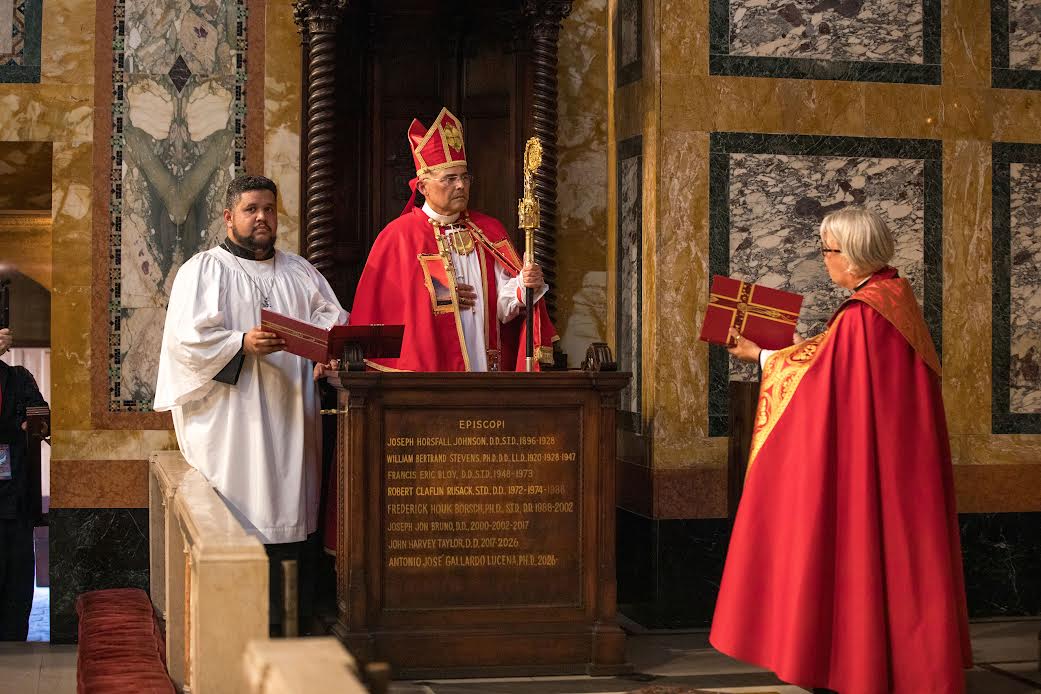
“In the name of the vestry of this cathedral church, and on behalf of the people of this diocese, I install you, Antonio, in the chair which is a symbol of your office,” Sawyer said. “May the Lord stir up in you the flame of holy charity, and the power of faith that overcomes the world.”
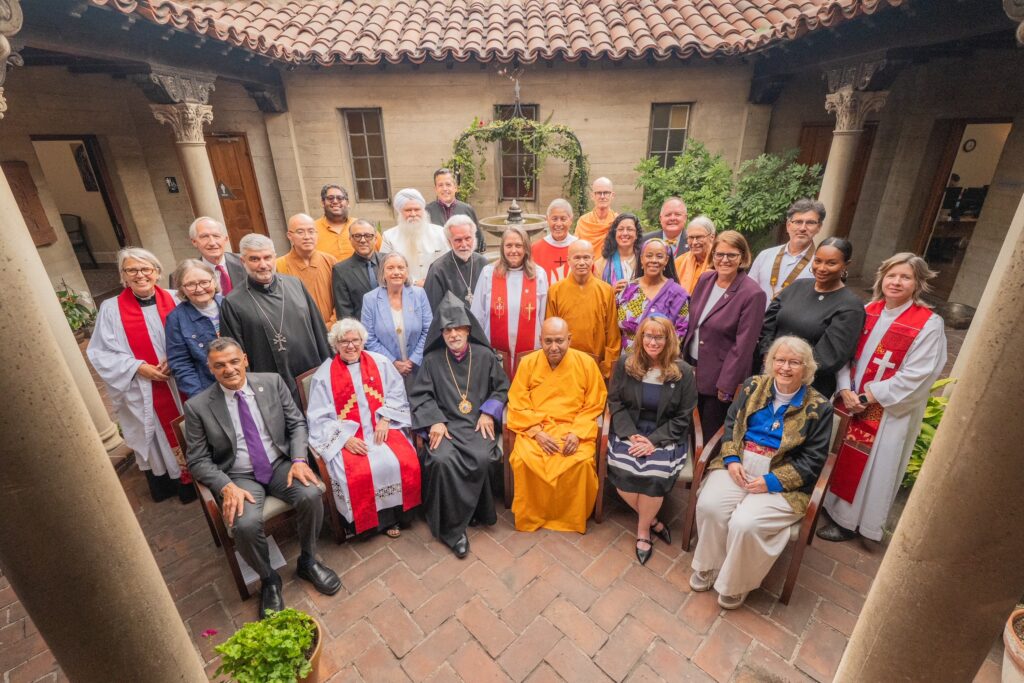
More than 25 interfaith and ecumenical guests attended the service at the invitation of Sawyer and Dr. Lo Sprague, president of The Guibord Center. Invited to offer prayers for Gallardo were Salam Al-Marayati, President of the Muslim Public Affairs Council; Archbishop Hovnan Derderian of the Western Diocese of the Armenian Church of North America; Temple Beth Hillel Rabbi Sarah Hronsky, president of the L.A. Council of Religious Leaders; and Swami Mahayogananda, Vedanta Society monastic and president of the Interreligious Council of Southern California.
“On this special day,” Mahayogananda asked that the new bishop “know and feel our prayerful aspiration that he be blessed to be a peacemaker, an instrument of peace in a world yearning for healing.”
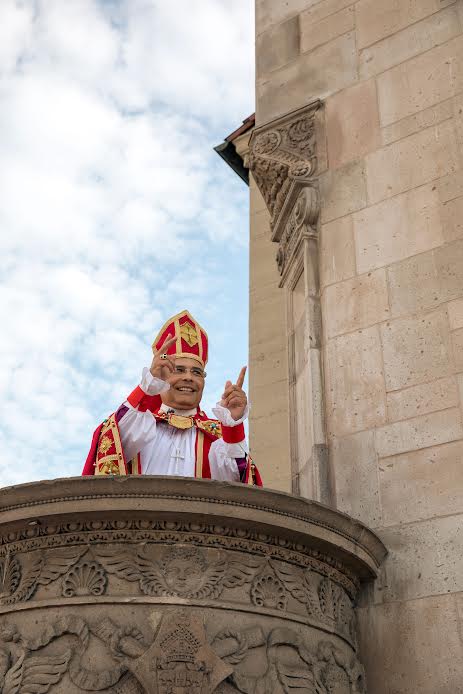
As the service concluded, Gallardo L. moved to the cathedral’s historic open-air pulpit as the congregation left the church while singing the South African freedom song “We are marching in the light of God.”
From the outdoor pulpit, symbolizing the church’s inclusive and prophetic mission rooted in the community, Gallardo L. offered blessings at the invitations of California state Sen. Maria Elena Durazo, recently elected to the L.A. County Board of Supervisors (District 1) to take office in December; Allen Moret, representing Los Angeles Mayor Karen Bass; and Dean Sawyer.
Earlier, Gallardo L. had commissioned the gathering: “Today, as we start a new stretch in our journey as a diocese, Jesus is asking us the question that matters: ‘do you love me?’ It will be only when we say ‘yes’, with a humble heart that Christ will tell us what our commission is.”
Through prayer, scriptures and life in community, “the Holy Spirit will enable us not only to answer Jesus’ question, ‘do you love me?’ with our lips, but to answer it with our lives. Before asking about vision, competence, or strategy for the diocese, Jesus asks us a more fundamental question, both personally and to our communities, ‘do you love?’ Let’s get our hearts ready to answer.”
Canon Earl Mounger, a St. John’s member since 1985, said Gallardo L.’s episcopate represents for him “a new turning point in the diocese. The whole culture is going to be enhanced by his episcopate. I am looking forward to the ideas he is bringing, especially his theme of love and truth. It’s going to bring the diocese together.”
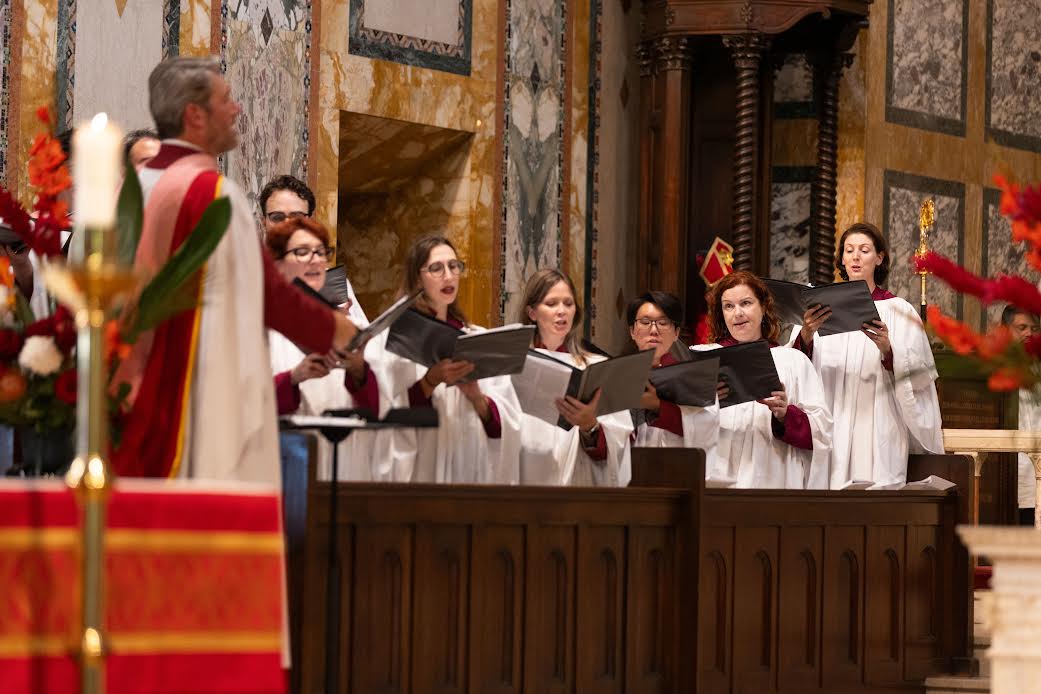
The cathedral choir, directed by Dr. Christopher Gravis, offered soul-stirring renditions of traditional hymns such as “Amazing Grace,” “Praise to the Lord,” and of the African American gospel song, “Leaning on the everlasting arms of Jesus,” along with the anthem “I was glad” by Sir Hubert Parry. Cathedral organist Dr. Zachery Neufeld accompanied the choir.
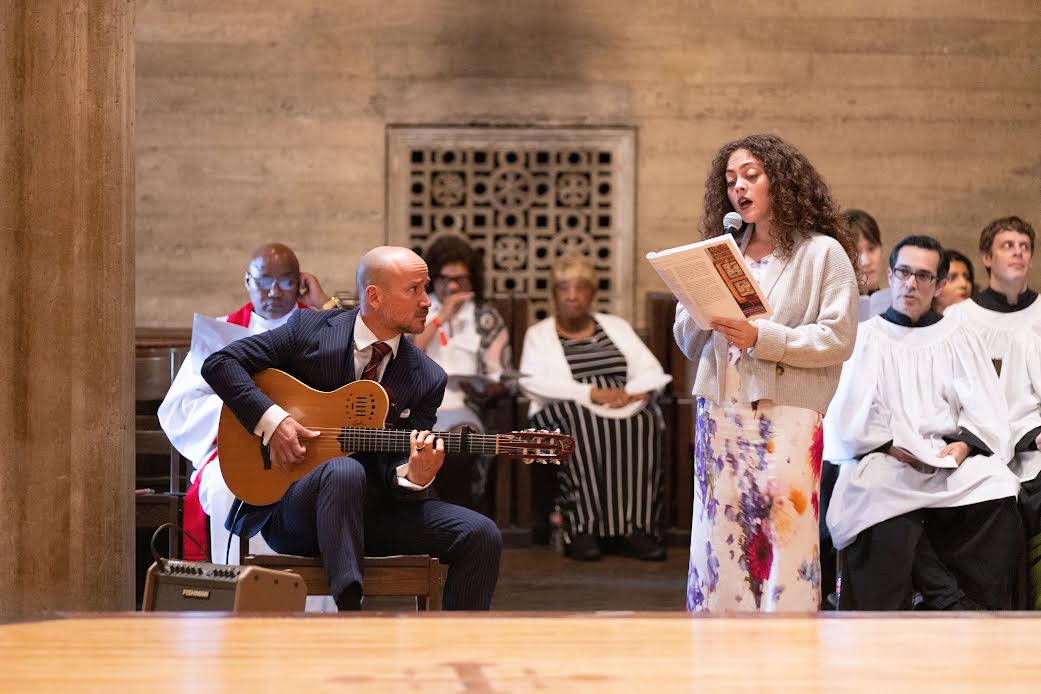
Guitarist Walter Molina and vocalist Caroline Espinoza performed “ Cristo es la Peña de Horeb ” (“Christ is the rock of Horeb”) and provided music during an outdoor reception following the service featuring empanadas, tequeños, cachapas, and other traditional Venezuelan foods.
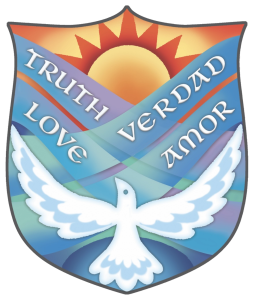
Afternoon breezes helped ease the weekend’s earlier warm and humid weather, and cathedral hosts provided guests with paper fans customized with the bishop’s “love and truth” emblem (opens in a new tab) for his new ministry.
Cooler temperatures were especially welcome to the dozens of people – from children to seniors – who joined Gallardo L. on the walk from Echo Park to the cathedral. Coordinated by the diocesan Sacred Resistance ministry, walk arrangements were led by the Rev. Canon Jaime Edwards-Acton, who joined the bishop in gathering participants with prayer.
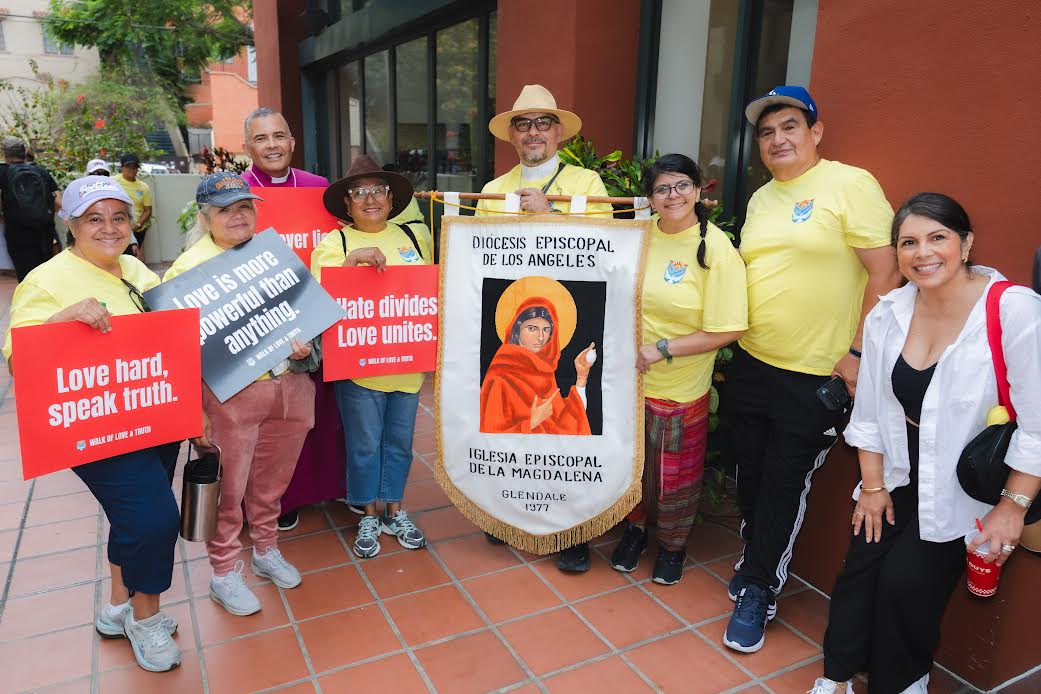
“We walk for love – love for the mother who scans the street before she walks her child to school,” the group prayed, “love for the worker taken from the job that fed her family, love for Black lives ended too soon and Black joy that refuses to die, love for queer and trans children of God, fearfully and wonderfully made, who should never have to choose between safety and truth, love for this wounded, burning earth – your creation groaning under fire and flood, crying out for jubilee.”
“The walk was very moving,” said the Very Rev. Melissa Campbell-Langdell, rector of All Saints/Todos los Santos, Oxnard (opens in a new tab) , and dean of diocesan Deanery 1. “As we progressed down the city streets from St. Paul’s Commons (opens in a new tab) to the cathedral (opens in a new tab), we not only passed large sports centers and busy financial buildings (one of which, the Price Cooper Waterhouse tower at Wilshire and Figueroa, is the site of the diocese’s former cathedral ), but we also interacted with people.
“As we departed the Echo Park area, many families were having ad hoc yard sales as we walked past,” Campbell-Langdell said. Some strangers and drivers cheered us on or honked in support. Others were unhoused, and we tried not to disturb their rest if they were resting.
“Others were individuals, some of whom asked questions. One gentleman stopped Bishop Antonio and asked, ‘What are you going to do to make the community better?’ In my mind, this walk, contemplative and focused on common values of love and truth, was a start.
“Showing the community we don’t just do elaborate services in cathedrals and other churches (although we are good at that), but we are also willing to walk in the community and show that love and truth, still means something, especially in polarizing times.
“It was contemplative but also energizing,” she added. “It took longer than expected so that we could stay together, but arriving all together felt important. That seems symbolic. We may go slower rowing together as a diocese but we will go farther and feel more unity. The cathedral worshippers and leaders were exceedingly gracious in waiting for us and seemed really to understand it was a two-part liturgy – walk and installation – in which we participated.”
The Rev. Roberto Martinez, vicar of La Magdalena, Glendale (opens in a new tab) , agreed: “It was a deeply meaningful experience.
“Walking alongside the bishop and members of the diocese through the streets of Los Angeles became more than a symbolic procession, it became a true pilgrimage.
“As we passed through the city’s diverse neighborhoods, each reflecting its own social reality, some marked by greater hardship, others by greater prosperity, we were once again confronted with the needs and challenges that are visible on the streets. All of this unfolded amid the joy and enthusiasm of the procession accompanying the bishop, serving as a powerful reminder of the missionary and evangelistic calling entrusted to us as the Church.
“At the same time, the experience challenged us,” said Martinez, whose congregation will host the diocese’s first deanery celebration welcoming the new bishop on July 18 (see related story below). “As a church, and as a diocese, how will we continue responding to the needs of the people who live in our communities, not only in the city of Los Angeles, but throughout the diocese?
“One particular moment during the walk stood out as especially profound. It felt almost as though God Himself had revealed an opportunity for a conversation with the bishop,” Martinez recalled. “A man suddenly approached him to speak. From where I was standing, I could not hear the exchange clearly, but at first those of us nearby grew somewhat uneasy, as the man appeared to be experiencing homelessness. Although he never behaved aggressively, he did challenge the bishop with several questions. The bishop responded with openness and compassion, engaging him in genuine conversation. There was true dialogue.
“By the end of their exchange, the man’s expression had changed. He smiled, embraced the bishop, shook his hand, and even asked someone to take a photograph of them together. It was a remarkable and revealing moment.
“The arrival at the cathedral was warm and joyful, filled with anticipation and a spirit of celebration, Martinez said. “For me, the entire experience was profoundly positive.”
Diocesan Canon for Common Life Bob Williams contributed reporting for this story.