by The Rev. Canon Pat McCaughan
Watch video remarks from Bishop Antonio
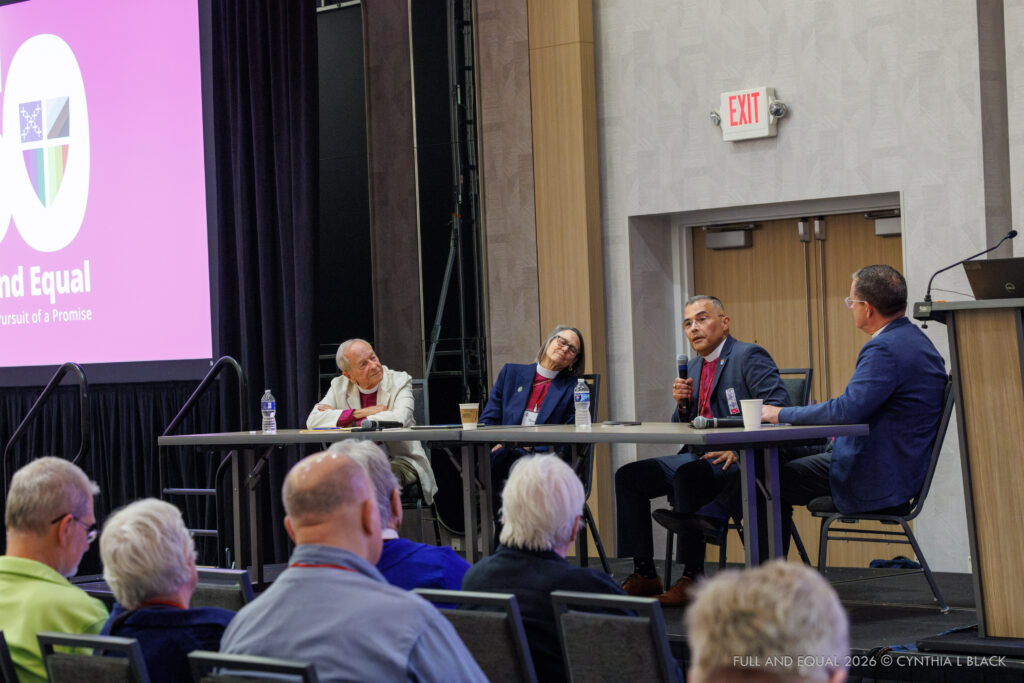
What’s next for the church is hope, change, and embracing diversity, Los Angeles Bishop Antonio Gallardo Lucena said during a Sept. 3-5 gathering in Minneapolis, celebrating The Episcopal Church’s five decades of progress toward LGBTQIA+ full and equal inclusion.
“Full and Equal: 50 Years in Pursuit of a Promise,” commemorated the 1976 General Convention resolution declaring, “that homosexual persons are children of God who have a full and equal claim with all other persons upon the love, acceptance, and pastoral concern and care of the Church.” Storytelling and panel discussions focused some 200 participants on inclusion in the church’s past, present, and future.
“I envision a future where we are all enriched by the diversity that we have, where there are opportunities at every level for everyone to live and be valued as perfectly as God created them, mainly in positions of leadership, in governing bodies, as heads of congregations, and leading worship,” Gallardo said.
“La lucha continua—the struggle continues, because lasting change only lasts if we keep up the struggle,” said the Rev. Canon Susan Russell, Diocesan Canon for Engagement Across Difference and chair of General Convention’s Task Force on LGBTQ+ Inclusion, which organized the gathering.
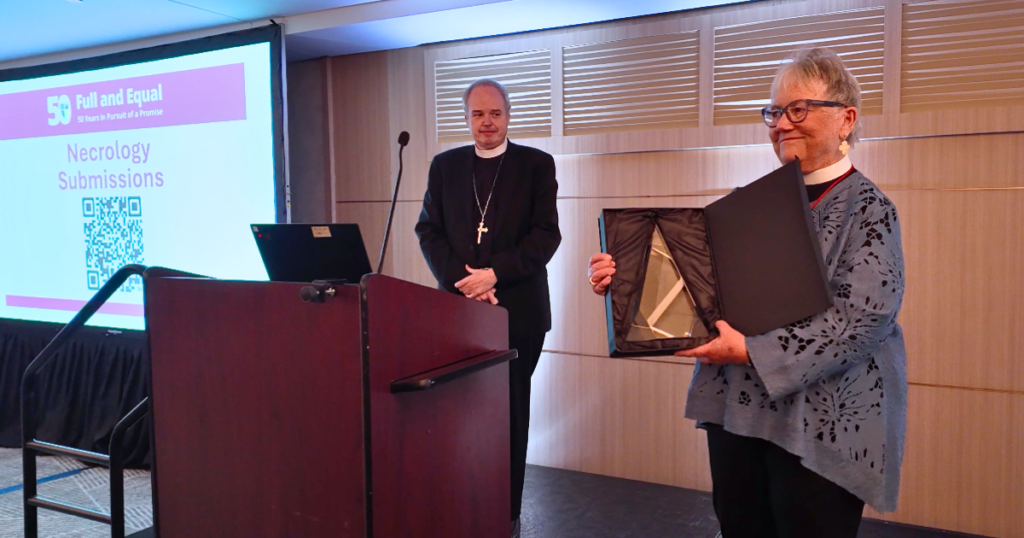
Presiding Bishop Sean Rowe honored Russell “for being an architect of lasting change” in the full and equal movement in The Episcopal Church and the Anglican Communion.
“Her leadership carried her from parish halls in L.A. to the global stage in 2008 at the Lambeth Conference where she stood in solidarity with Gene Robinson, a public act of witness to the worldwide Anglican Communion,” Rowe said. “Time and again, she stepped up, speaking truth, challenging flawed theology and persisting in the face of many setbacks.”
Robinson, the first openly gay bishop in The Episcopal Church, preached at the closing Eucharist, said he felt humbled to have played “a small part” in the last 50 years journey to the dream of full inclusion.
“The General Convention resolution passed 50 years ago was a declaration of a dream, dreamt by queer forebears and allies about a better church and world, which they knew they would never live to see accomplished, but who joined in the dreaming and working toward it anyway.”
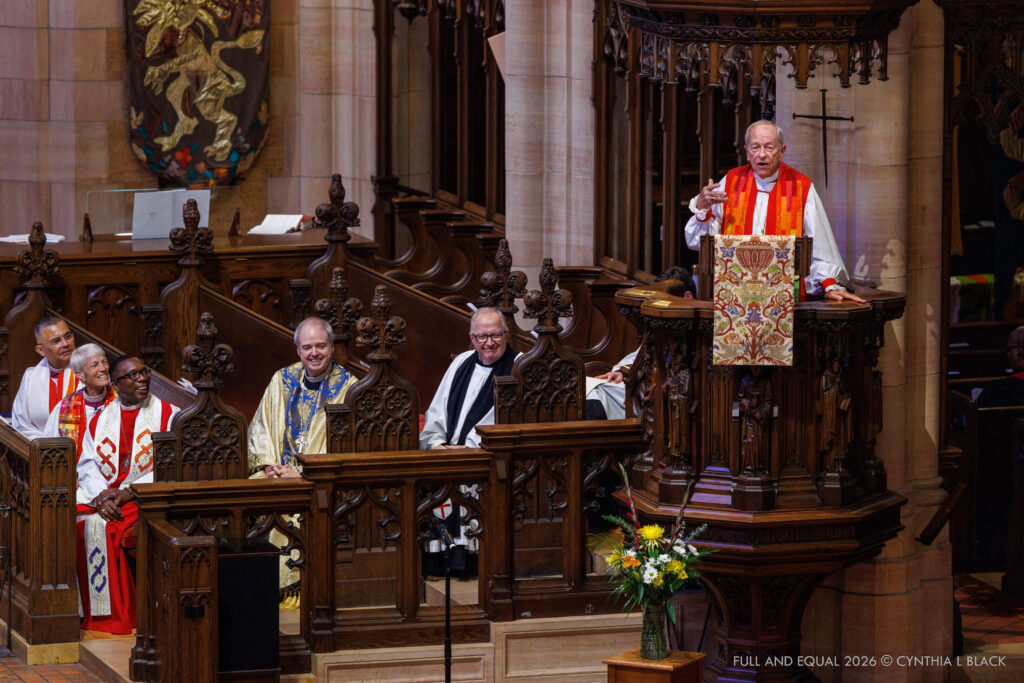
The dream will bring “the full inclusion of not only those of us who are queer and beloved in the eyes of God, but those who are also excluded for other reasons, some of whom we haven’t even yet noticed. So that all of God’s children, even those who now oppose us. All of God’s children will become beneficiaries of that dream we articulated 50 years ago.”
Gallardo also envisioned “a future where we are all enriched by the diversity that we have, where there are opportunities at every level for everyone to live and be valued as perfectly as God created them, mainly in positions of leadership. A future where the money supports this richness in budgets, in salaries, in resources, and I don’t think it’s my vision, I think it’s God’s vision for us from the moment of creation.”
Citing his own experiences in congregations where budgets were reduced “for people like me, where I was going to be paid less than by predecessors, even when I had comparable or more skills, abilities, and experience.”
In a recent regional meeting within the diocese, Gallardo shared that the diocese is producing all its communication materials both in Spanish and English, following the example set by The Episcopal Church to speak to the language of the hearts of most of our people. “People who come to this country learn English to advance in the pursue of their dreams, and yet, their spirit is touched differently when we communicate with them in the language of their hearts.”
Knowing that “the least resourced communities in our diocese are those communities of color. When my Trans clergy colleagues are afraid that they won’t be able to find a job as a head of a congregation—those things keep me awake at night,” he added.
“So, what I think is, ‘how may I use my position to promote God’s vision for us, so that people could live and love like Jesus? I think about Gene (Robinson). I think about Susan (Russell). I think about the Rev. Cynthia Black, and many others who paved the road for us. I want to be one of those that pave the road for those in the future.”
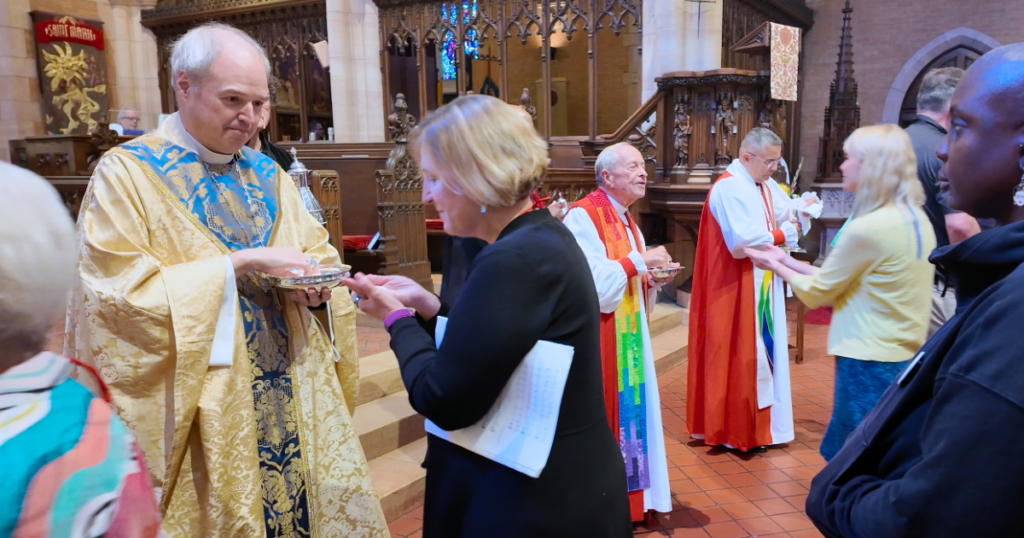
There is also work to be done in some communities that have not traditionally aligned with people who don’t fit into the binary spectrum, he said.
The Rev. Neil Tadken, rector of St. Luke’s, Monrovia, who also attended the gathering, said the 50 years of work is truly amazing and the hurdles overcome were extraordinary. “For me, it’s a chance to honor those people who made my vocation possible. To have those moments of being able to say, ‘thank you for giving me a life in the church that was an utter surprise to me, and amazingly fulfilling’.”
Former L.A. Suffragan Bishop Mary Glasspool sent greetings to the diocese and said the importance of the gathering “is to both tell our stories and share our stories and to be a part of the ongoing narrative of the church, of the full and equal inclusion of basically all people. We’re focused here on the LGBTQIA+ community; it is kind of a misuse of the word because we’re all different, we’re all unique, we’re all individual, and we’re all children of God, beloved children of God.”
Gallardo agreed. “The future is enriched by the diversity we have in God’s kingdom. We are a church where everyone is welcome. Where we struggle with things, where we have opportunities to disagree in safe spaces and where progress can be made. For me the future of the church is hope. Welcome to this your Episcopal Church.”